

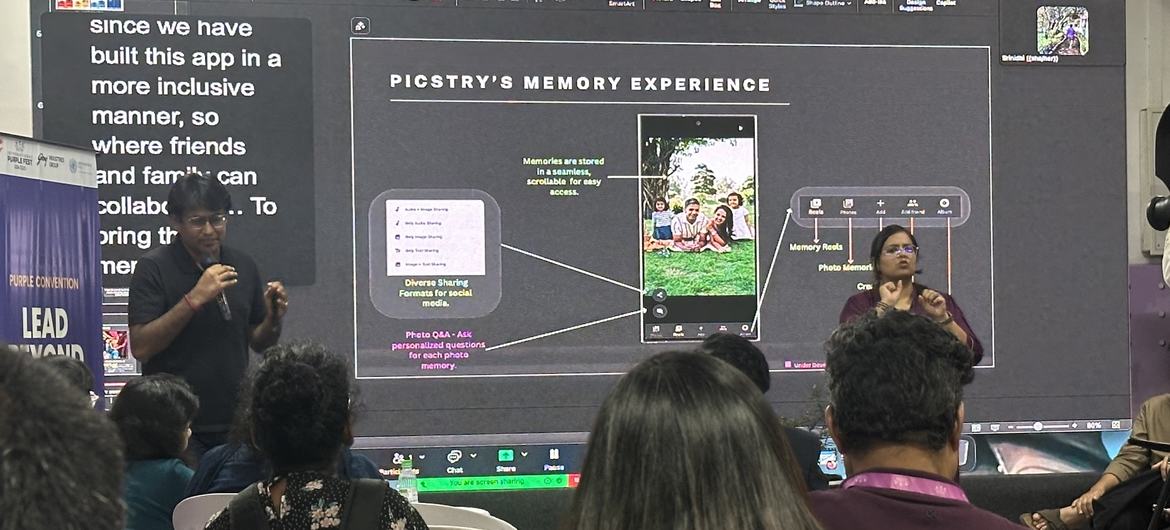
At the International Purple Fest held in Goa, the United Nations spotlighted the transformative potential of artificial intelligence in empowering persons with disabilities. The event, co-hosted by the Indian Ministry of Social Justice and Empowerment and UN India, showcased how AI-driven assistive technologies are reshaping accessibility, education, and employment.
From voice-to-speech tools and gesture-controlled wheelchairs to real-time captioning and adaptive learning dashboards, innovators demonstrated how AI is turning barriers into bridges. “AI has become the great equaliser,” said Prateek Madhav, CEO of AssisTech Foundation. “While the world worries about AI taking jobs, for people with disabilities, AI is creating them.”
Lived Experience at the Heart of Innovation
Entrepreneur Surashree Rahane, born with multiple physical disabilities, emphasized the need for inclusive design. As CEO of Yearbook Canvas, she collaborates with Newton School of Technology to develop AI-based learning tools tailored to diverse student needs. “AI can democratize access to education,” she said, “but only if we teach it to understand diverse learners. Otherwise, we risk building a shinier version of the same old bias.”
Ketan Kothari of Xavier’s Resource Centre for the Visually Challenged echoed this sentiment, sharing how AI tools have enabled him to work independently—formatting documents, joining meetings with live captions, and generating visual descriptions.
Global Momentum for Inclusive Tech
UN officials stressed that disability inclusion is not just a national issue but a global imperative. “This is not a single-country story it’s a global transition,” said Tshering Dema of the UN Development Coordination Office. “The future of work must be built not just for people, but with them.”
Purple Fest 2025 ran from October 9–12 and featured entrepreneurs, policymakers, and advocates committed to building a more inclusive digital future.

Moaz serves as Editor-in-Chief of TWW News, where he leads editorial strategy, content development, and newsroom standards. He specializes in high-impact reporting on artificial intelligence, governance, and institutional transformation.