
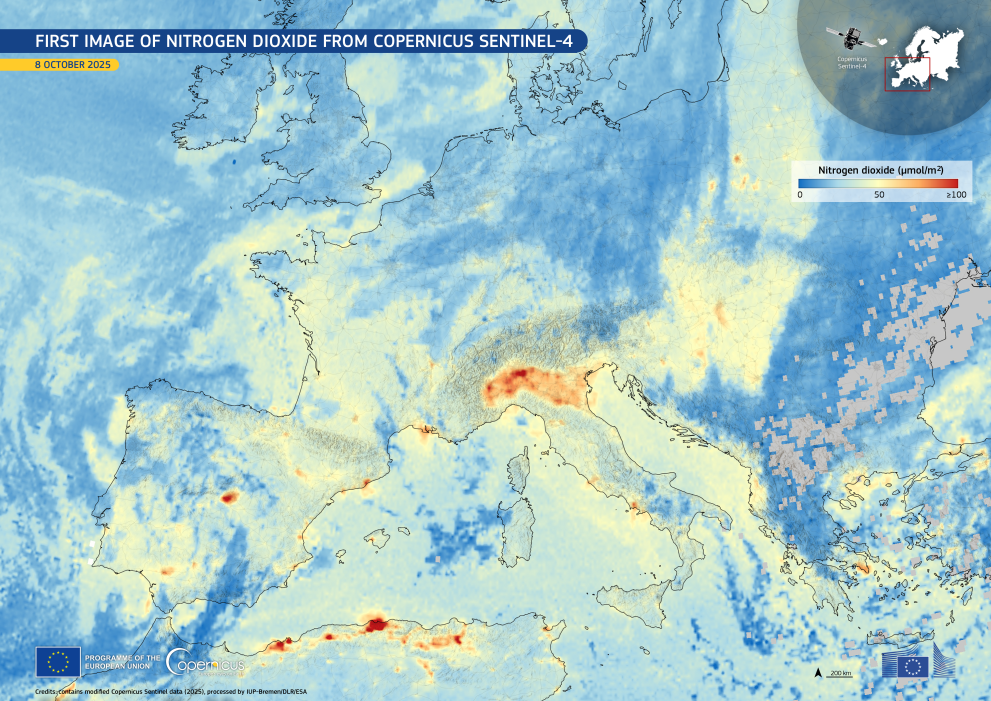
Brussels The European Commission has unveiled the first image captured by the Copernicus Sentinel-4 satellite, showcasing concentrations of nitrogen dioxide (NO₂) across Europe. This marks a major milestone in the EU’s ability to monitor air quality from geostationary orbit, 36,000 kilometers above Earth.
The image, based on data collected on 8 October 2025, reveals pollution hotspots along the Mediterranean coast and over Italy’s Po Valley, areas known for high fossil fuel combustion from vehicles, power plants, and heating systems. Nitrogen dioxide is a toxic pollutant that contributes to the formation of ozone and particulate matter, both of which pose serious risks to human health and the environment.
Key mission highlights:
- Sentinel-4 was launched on 1 July 2025 from Cape Canaveral
- It is the first geostationary Copernicus mission dedicated to air quality monitoring over Europe
- Equipped with a UVN spectrometer, it measures pollutants including ozone (O₃), NO₂, SO₂, formaldehyde (HCHO), and aerosols
- Once fully calibrated, it will deliver hourly data to support real-time environmental analysis
The data will feed into the Copernicus Atmosphere Monitoring Service (CAMS), helping scientists, policymakers, and environmental agencies track pollution trends and implement mitigation strategies. The mission directly supports EU environmental goals under the Ambient Air Quality Directive and the Zero Pollution Action Plan.

Environment Correspondent, TWW News
Diya is a journalist at TWW News specializing in environmental reporting with a global lens. Her work spans climate policy, conservation breakthroughs, and the intersection of ecological justice and geopolitics. With a sharp eye for data and a commitment to public accountability, Diya covers stories that matter—from rising sea levels to green tech innovation—with clarity, urgency, and impact.
She brings a background in environmental science and field reporting, often spotlighting underrepresented communities and frontline climate defenders. At TWW News, Diya’s coverage is engineered for credibility, legal rigor, and Global grade editorial standards, helping readers navigate the complexities of a changing planet.